Jumaat, 23 September 2011

Shanghai's young high rollers splurge on luxury

Kelly Ying, one of a swelling group of young high-rollers in Shanghai, has just treated herself to a birthday present of a $45,000-dollar watch.But the 30-something -- who likes "big watches" -- has elected not to wear what she calls her "PP" (Patek Philippe) today, opting instead for an imposing, gold-plated Rolex Daytona that she bought for her previous birthday.
   Thousands of rich Shanghai residents like Ying have turned China's most cosmopolitan city into the luxury capital of a country that is expected to become the world's largest market for the sector between 2012 and 2015.According to the World Luxury Association, Shanghai topped China's luxury market in 2010-11 with 18.3 percent of overall sales, ahead of Beijing's 16.2 percent and the eastern city of Hangzhou, with its 13.4 percent share.
   Second and third-tier cities in the country -- which Forbes magazine says has 146 dollar billionaires, second only to the United States -- are still far behind, despite boasting a growing number of wealthy people."Shanghai is certainly the city where most (luxury) brands have their headquarters," Angelica Cheung, editor of Vogue magazine in China, told AFP."There is a tradition -- already in the twenties and thirties, Shanghainese were more into dressing stylishly," she said.According to Cheung, Shanghai is also a "commercial city", and for a long time, Beijing's real-estate market was not ready for large luxury malls, even if that has now changed.
  Shanghai counts 132,000 residents that have more than 10 million yuan ($1.6 million) at their disposal, and as such has a reservoir of customers who can spend a fortune on luxury goods -- with French and Italian brands in the lead."I'm a fashion victim... and I'm a shopaholic," jokes Ying -- the owner of a modern art gallery -- standing tall on five-inch heels, sporting an elegant peach-coloured pair of shorts and a silk blouse.Ying -- who also has a 600,000-yuan diamond engagement ring she qualifies as "not very expensive" on her finger -- says she has dozens of bags and lots of luxury clothes.
   "Every three months, I empty my closet and give out bags, accessories... Fashion changes very fast," she said."Shanghai people have a better sense of fashion, luxury customers are more sophisticated, so you need to do a lot more marketing and merchandising."The French label Hermes last year chose Shanghai to launch Shang Xia -- a luxury brand that incorporates a blend of traditional Chinese craftsmanship and contemporary design.Last week, Patrick Thomas, head of Hermes, said Shang Xia's results were "largely above expectations" even if the brand has yet to make a profit -- with 60 to 70 percent of its customers Chinese.
   At the city's most luxurious shopping mall -- the Plaza 66 -- young saleswomen wearing black dresses, their hair done up in buns, and security men with ear pieces and white gloves welcome clients.On its five floors, the world's most prestigious brands -- from Dior to Chanel, Prada to Versace, Armani to Louis Vuitton, Hugo Boss to Bulgari -- compete to attract the attention of Shanghai's wealthy."We don't feel the impact of the crisis," says the director of the Tod's store, who only identified herself as Judy.This is confirmed by Nicola Adamo, guest relations manager at the Dolce & Gabbana shop. "What most of them want is brand names. Money is not a problem, and if they like the brand, they can spend 100,000 yuan," he said.
   Adamo said one customer once spent $68,000 in one go. "They come for a total look, not just a pair of jeans," he added.Consultants KPMG said in a recent report that one unique characteristic in China was the high number of young millionaires -- "far younger than their Western counterparts," it said.These consumers passionately follow fashion online, particularly on blogs. Shanghai residents have a reputation of being smarter customers who compare prices more, according to Vogue's Cheung.
They also travel a lot and buy luxury items in Hong Kong, Milan, London or Paris.Ying, for instance, dished out 5,500 euros ($7,500) in Paris for a watermelon-coloured Birkin bag -- made by Hermes and considered a symbol of wealth due to its high price and elusiveness."It's very difficult to get in China, and many of my friends would be willing to pay double to get a Birkin," she said.

Selasa, 20 September 2011

Emma Watson likes the natural look

Emma Watson says her biggest beauty faux-pas is wearing too much make-up. The 'Harry Potter' actress prefers the natural look and hates piling on cosmetics as she thinks beauty comes from within. She said: "The funny thing about me is that I do have a lot of products - I've always loved make-up and its ability to transform you. But I don't actually wear a lot of it, so there is an irony that I own so much of it but wear so little. But I do love beauty products. "But wearing too much make-up has been my biggest beauty faux-pas. I truly, truly believe that beauty is something that comes from within. You can only really look beautiful if you feel beautiful on the inside. It shows through your face, the way you move and the way you hold yourself." The 21-year-old beauty also gave other tips on how to look good. She told Britain's Hello! magazine: "Don't over-pluck your eyebrows and always take your make-up off before you got to bed."

Ahad, 18 September 2011

Sarah Jessica Parker prepares for grown-up kids

Sarah Jessica Parker is already planning for her children leaving home.
The 46-year-old actress - who has children James, eight, and twin daughters Tabitha and Marion, two, with husband Matthew Broderick - admits she and her spouse have lots of ideas of what they will do when they find themselves sharing an empty house in years to come.
Asked how they keep their marriage alive, she said: 'We go to the theatre and to dinner and we occasionally see friends. And we talk a lot about when the kids are grown and gone and all the things we'll do.'
    The 'I Don't Know How She Does It' star also revealed her favourite way to unwind is by watching property programmes on television - but she has to wait until her children are asleep before she can tune in.She explained: 'It's really only when the children are in bed - and really in their beds, not their fake, pretending to be cooperative going to sleep, but when I hear deep breathing - that I have any free time.
    'And what I do is watch 'House Hunters International.' It's not even a guilty pleasure- I make very public statements about how much I love it.'They're just real people looking to buy a home or a holiday home and it's just fascinating. I cannot get enough of it.'And then sometimes my son will stub le down all crazy from attempted sleep and go, 'Oh my God ) I've seen this one. They buy the second house in Romania.' '

Man United manager wary of upcoming Chelsea clash

The spotlight has been off Chelsea, who have been challengers for the last seven years, and switched closer to home with Manchester City joining near-neighbours United at the top of the Premier League.
But Ferguson says the focus and publicity being away from the Londoners will suit Villas-Boas down to the ground.The top-flight’s youngest coach would have been boosted by the settling in period as he finds his feet in his new home.
   And although the 33-year-old former Porto manager faces his biggest challenge yet when he faces Ferguson on Sunday, the Manchester United manager anticipates his side will still be taking on one of their biggest rivals to their crown."They will be there at the end of the season, there is no doubt about that," Ferguson said."At the moment, of course, the two Manchester teams are enjoying the publicity that comes from the predictions that they are going to be involved in the winning of the league.
"In the background lurks Chelsea. They don't need the publicity. They will be enjoying being out of the profile at the moment."
   Ferguson has praised Villas-Boas for adapting to his new surroundings at one of the biggest clubs in Europe.Having replaced Carlo Ancelotti after arriving from Porto in the summer, Ferguson believes he has already left his mark on his new team."The new coach has started very well. For a young man who has come to Chelsea, it is a great challenge," he said."It is a hard challenge at his age but when you go to a new club, you hope you get an immediate response. He has got that."
"They are a team with great experience and they will always be a challenge to us.
"But it will be a fantastic game. The games between both sides over the last seven years have been very close affairs. There is usually just one goal in it and it will be very tight again."
Ferguson has reported no fresh injury concerns from their Champions League game in Benfica, with captain Nemanja Vidic (calf), Tom Cleverley (foot) and Rafael (shoulder) still out, while Danny Welbeck is not yet ready to return.Villas-Boas, meanwhile, has attempted to distance himself from the idea that this fixture will lay down a marker in the title race.
Chelsea are two points behind the Manchester duo after four games, but Villas-Boas makes the point that there are still 32 matches left in the season.
   "It's early. In my small experience in this life, and observing the behaviour of the Premier League table, it won’t be determinate for the table," he said.
"Whatever happens in the game is not decisive because of the ‘pattern’. If you focus on statistics and you can see how many points United were behind Newcastle 10 or 15 years ago, or Chelsea were last season."It's the fifth game of the season, and it’s still early. Any manager who is judged after five games of a season, there’s not something wrong with the manager but something wrong with the people who run clubs."Villas-Boas, who is still without striker Didier Drogba but will welcome back Frank Lampard and John Terry to the starting line-up after resting them for the Champions League fixutre on Tuesday, added: "We have made a good, strong start in the Premier League.
    "This game comes at a good time for us. Both teams feel very motivated and strong, so hopefully this will be enough for the spectacle to be excellent, which all of us should hope for."

Isnin, 12 September 2011

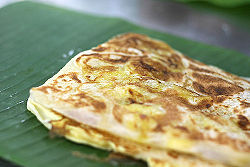
Roti canai

Roti Canai

Roti canai (pronounced "chanai," not "kanai") is a type of flatbread found in Malaysia, often sold in Mamak stalls. It is known as roti prata in Southern Malaysia and Singapore, and is similar to the Indian Kerala porotta.

Origin of the word

Roti means bread in Hindi, Urdu, most other North Indian languages, and Malay. The term "canai" derives either from:
  • Chennai, a city in India which is formerly known as Madras. Roti canai is presumed to have been introduced by immigrant labour from the Madras region where a similar combination of parotta and dalcha - the accompanying lentil curry - is served.[1]
  • Channa, a dish made with boiled chickpeas in a spicy gravy from Northern India which this type of bread was traditionally served. However, the roti in Northern India is different from that served in Malaysia. The latter is more similar to the South Indian parotta, and roti canai is often served with dhal or lentils curry rather than chickpeas.
  • The word 'canai' in Malay means 'to knead'.
Roti canai is circular and flat. There are two ways to make roti canai that is either to twirl it until the dough becomes a very thin sheet and then folded into a circular shape or to spread out the dough as thinly as possible before being folded. Then the folded dough is grilled with oil. The first method is more popular and faster than the second. The term 'roti paratha' in Malay means 'plate bread'.In English and in Chinese, roti canai is sometimes referred to as "flying bread" (飞饼 fēibǐng), a term that evokes the process of tossing and spinning by which it is made. In Chinese, Roti Canai is originally called 印度煎饼 "yin du jian bing", which means Indian Fried Biscuit (Bread).

The roti canai dish

Composition

The dish is composed of dough containing copious amounts of fat, egg, flour and water (although eggless vegan versions do exist). The form of fat used is usually ghee (clarified butter). Some people add sweetened condensed milk to the mix. The entire mixture is kneaded thoroughly, flattened, oiled and folded repeatedly. It is then allowed to proof and rise, and the process is repeated. The final round of preparation consists of flattening the dough ball, coating it with oil and then cooking on a flat iron skillet with a lot of oil. The ideal roti is flat, fluffy on the inside but crispy and flaky on the outside.

 Consumption

One of the characteristics of roti canai and its derivatives is that it can be eaten with the hands, without the need for utensils. This makes it a convenient dish to consume, while being filling. This characteristic makes it a dish of choice as breakfast or as late night supper.Traditionally, it is served with dal or 'dhal' (lentil) curry, which in North India is prepared with chana dal. It can sometimes be taken with sugar or condensed milk. More recently, various improvements on plain roti have been devised to suit Malaysians. Generally the newer forms of roti canai are denoted by prefixing roti to the additional ingredient used. Common variations include:
  • roti telur, with fried eggs (telur being the Malay word for egg)
  • roti tisu (tissue bread), a paper-thin and flaky roti. Also called roomali roti, from roomal (Hindi, meaning handkerchief).
  • roti bawang (onion bread)
  • roti boom (bomb bread), a smaller but thicker roti, usually round in shape.
  • roti planta, stuffed with margarine (often Planta Margarine) and sugar.
  • roti sardin, stuffed with sardine and sometimes mixed with ketchup or sambal, similar to murtabak
  • roti pisang, banana bread
Some consumers may also order their own variation, such as:
  • roti telur bawang, with eggs (telur) and onions (bawang)
  • roti kaya, with kaya
  • roti tampal, similar to roti telur but the eggs are sticked on the outside instead
  • roti tuna, stuffed with tuna
  • roti cheese, with cheese added
  • roti milo, although not common, some consumer requested that the roti is sprinkled with Milo powder
  • roti babi, stuffed with pork.
  • roti kacang, cooked with lentils or beans
  • roti ayam, cooked with chicken stock
  • roti A&W, replaces shortening with A&W root beer. The result is carbonated and fluffy but not crispy rotis.
  • roti kopi, served with shredded coffee bean. Only found in Sacred Mamak, Kuala Ibai
There are also a lot of different curries used besides dhal, for example:
  • kari ayam, chicken curry
  • kari daging, beef curry
  • kari kambing, mutton curry
  • kari ikan, fish curry (mostly served with stingray)
  • kari campur, mixed curry (consumers can select a mixture of dhals themselves)
Most plain roti are round, while those with fillings are square in shape due to the folding of the roti. Due to time saving concerns, the maker usually has a "stock-ready" bucket that keeps pre-made roti. These rotis are usually round in shape and will eventually become cold. Therefore, consumers might insist on a square roti to ensure they get a freshly prepared one.Roti canai is affordable in Malaysia (the standard price is RM0.90 a piece in Malaysia), making it extremely popular there. It is also available in frozen form whereby pre-fried roti canai is processed through a blast-freezing technique to ensure a soft and fluffy texture upon defrosting and refrying.Some hawkers serve fluffy and crispy roti canais by placing fried roti canai on a flat surface and giving them a soft clap with both hands

 Preparation of roti canai in pictures

Step 1

 The mixture is kneaded, flattened, and then oiled, before being folded repeatedly.

Step 2 
Roti canai is cooked on a flat iron skillet with a lot of oil.
 
Step 3

Another picture of Roti Canai making.
 
Last Step
A sweet Thai roti kluai khai: similar to roti canai, it is folded around a filling of sliced bananas and egg


Desert Traditional - Cendol

Cendol (pronounced /ˈtʃɛndɒl/) is a traditional dessert originating from South East Asia which is still popular in Indonesia, Malaysia,Myanmar (where it is known as Mont let saung), Singapore, Vietnam, and Southern Thailand where it is called lortchorng singapore ลอดช่องสิงคโปร์).

Etymology

There is popular belief in Indonesia that the name "cendol" is related to and originated from the word jendol; in Javanese, Sundanese and Indonesian, it means "bump" or "bulge", it refer to bumpy ensations of the green worm-like jelly passed through the mouth during drinking es cendol. In Malaysia, some cendol makers have been selling cendol for past three generation, since 1920. In Vietnam, it is called "bánh lọt," or fall cake. Bánh lọt is a common ingredient in a Vietnamese dessert called chè, or more commonly chè ba màu.

Ingredients

He dessert's basic ingredients consist of coconut milk, a worm-like jelly made from rice flour with green food coloring (usually derived from the pandan leaf), shaved ice and palm sugar. Next to these basic recipe, other ingredients such as red beans, glutinous rice, grass jelly, creamed corn, might also be included.

In Sunda, Indonesia, cendol is a dark green pulpy dish of rice (or sago) flour worms with coconut milk and syrup of areca sugar. It used to be served without ice. In Javanese, cendol refers to the green jelly-like part of the beverage, while the combination of cendol, palm sugar and coconut milk is called dawet. The most famous variant of Javanese es dawet is from Banjarnegara, Central Java.
The affluence of Singapore, as well as Western influence, has given rise to different variations of cendol. One can occasionally come across variants such as cendol with vanilla ice-cream or cendol topped with durian

Selling

Cendol has become a quintessential part of cuisine in Southeast Asia and is often sold by vendors at roadsides, hawker centres and food courts. Cendol vendors almost ubiquitous in Indonesian cities, especially Jakarta, Bandung, and Yogyakarta. Originally cendol or dawet in Java was served without ice, however after the introduction of refrigeration technology, the cold cendol with shredded ice was available and widely popular. It is possible that each country developed its own recipes once ice became readily available. This explains why it is most popular in Malayan port cities such as Malacca, Penang and Kuala Lumpur where British refrigerated ships technology would provide the required ice.In Malaysia and Indonesia, cendol is commonly sold on the roadside by vendors. It is even dessert fare in Singapore, found in dessert stalls, food centres, coffee shops and food courts.